
Not Every Datacenter Is an Existential Threat
There was a recent post from the Hutchinson Economic Development Authority addressing rumors surrounding a proposed datacenter project in Hutchinson. The post clarified that no formal paperwork had been filed yet.
That is an important detail. At this point, there are still unknowns.
We do not know the final design, the power requirements, the water usage, the ownership structure, the tax arrangement, or the long-term economic impact. Those are all fair questions for the community to ask.
But we should also be careful not to assume every project with the word “datacenter” attached to it is the same thing.
A lot of the online reaction seems to treat this proposed Hutchinson project like it is one of the massive AI datacenter campuses making national headlines. Based on the publicly discussed size, that does not appear to be the case.
The proposed site is reportedly around 80,000 square feet on the east side of town in the industrial area.
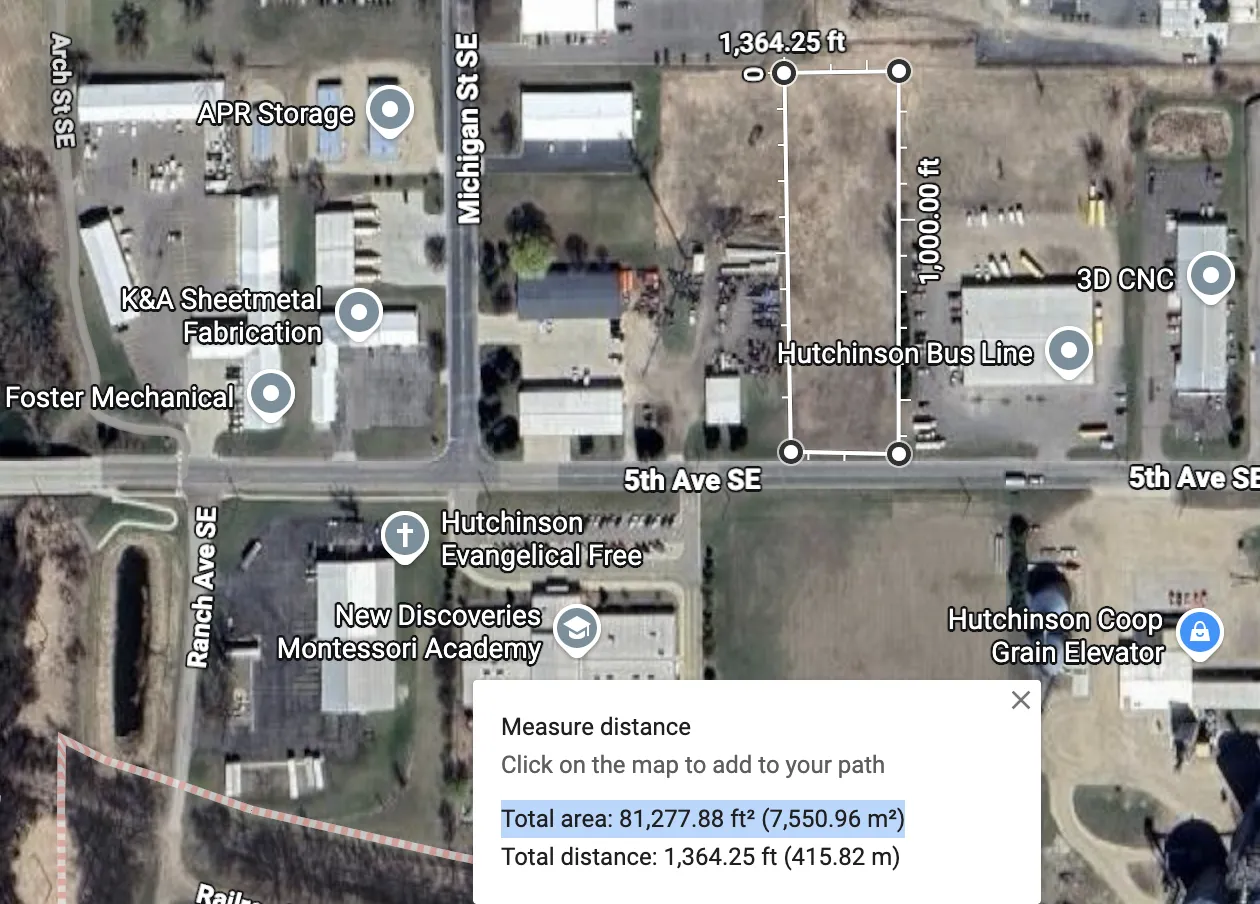
That may sound large, but in the world of datacenters, that is a relatively modest footprint. Once you account for setbacks, parking, loading areas, utility access, cooling equipment, and general site layout, this appears much closer to a small regional colocation or enterprise-style facility than a hyperscale AI campus.
That distinction matters.
Scale Changes the Conversation
Here is a quick visual comparison between a typical hyperscale datacenter campus and the size of what appears to be proposed in Hutchinson:
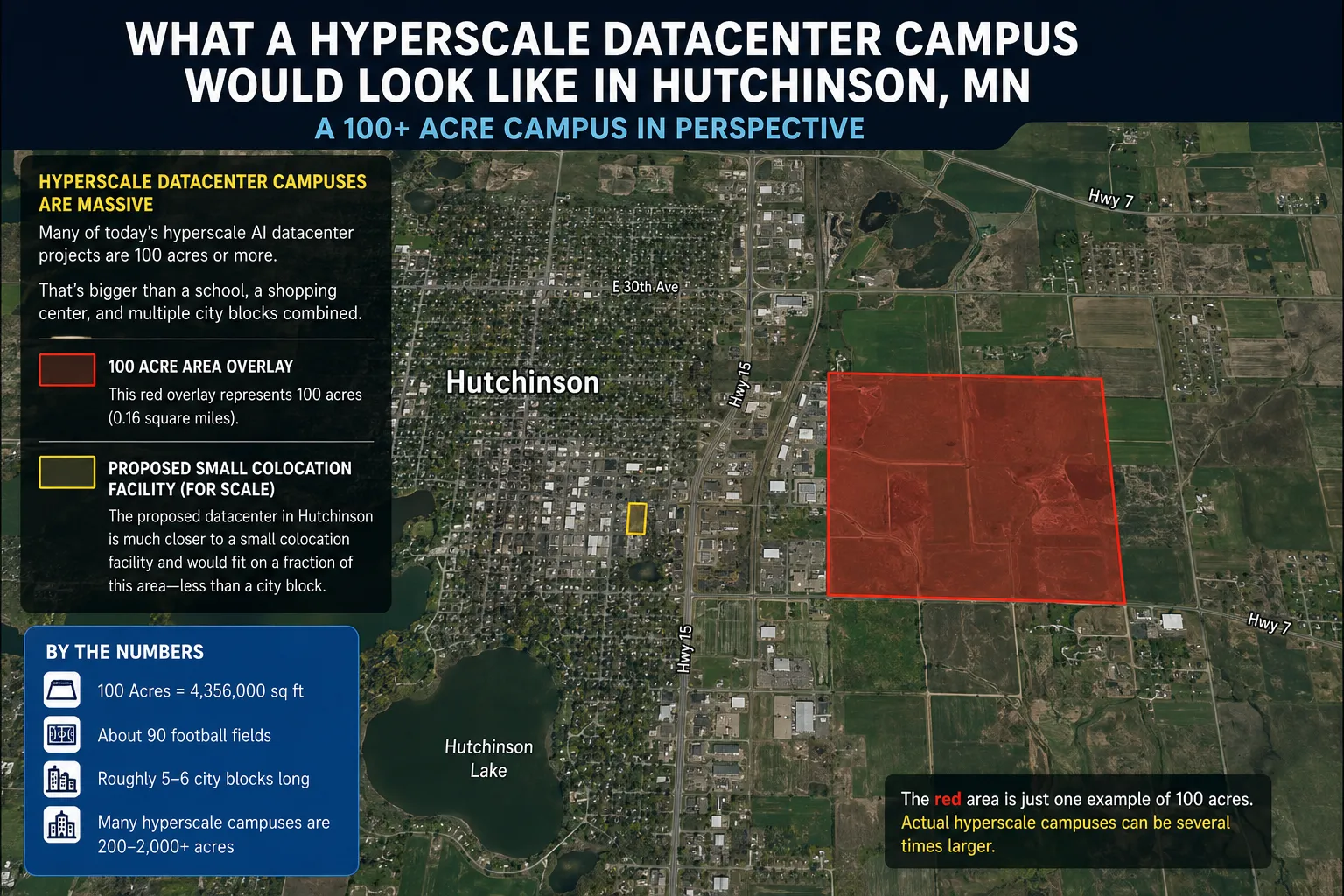
An 80,000 square foot site is about 1.8 acres.
By comparison, many hyperscale datacenter campuses are 100 acres or more. Some are several hundred acres when fully built out.
To put that into perspective:
- 80,000 square feet is roughly the size of a medium-sized industrial building or small warehouse site
- 100 acres is about 4.3 million square feet
- A 100-acre campus is more than 50 times larger than an 80,000 square foot site
Those are very different projects.
The concerns people have about massive AI datacenter campuses are not imaginary. Large hyperscale projects can consume enormous amounts of electricity, require major utility upgrades, use significant water depending on cooling design, and sometimes receive large public subsidy packages while creating fewer long-term jobs than people expect.
Those are real issues.
But applying those concerns directly to every smaller datacenter proposal can lead to a distorted conversation.
What We Should Be Asking
None of this means Hutchinson should approve anything blindly.
A datacenter, even a smaller one, is still infrastructure. The city and community should ask practical questions before any project moves forward.
Some of the right questions include:
- How much electricity would the facility require?
- Would it require utility upgrades?
- Would it use water for cooling?
- How much water would it use?
- Would there be backup generators on site?
- What noise controls would be in place?
- How many permanent jobs would it create?
- Would the city offer tax abatements, TIF, or other incentives?
- What would the net tax benefit be after incentives?
- What happens if the facility changes ownership or use later?
Those are reasonable questions.
The point is not that every datacenter is automatically good. The point is that every datacenter is not automatically bad either.
Not All Datacenters Are the Same
The word “datacenter” covers a lot of very different things.
It can mean:
- A small regional facility hosting local business servers
- A colocation facility where companies rent secure rack space
- A carrier hotel where internet and telecom providers interconnect
- A private enterprise datacenter for a hospital, manufacturer, or financial institution
- A cloud facility supporting regional workloads
- A massive hyperscale AI training campus with hundreds of thousands of GPUs
Those are not interchangeable.
A small regional colocation facility and a multi-hundred-acre AI training campus have about as much in common as a local airport and a major international cargo hub. They are related categories, but the scale, purpose, and impact are completely different.
Small Regional Datacenters
Smaller regional datacenters are often used for:
- Colocation
- Backup and disaster recovery
- Managed hosting
- Business continuity
- Local or regional connectivity
- Low-latency services
These facilities can provide real upside when they are sized appropriately and when the public deal makes sense.
Potential benefits include:
- Better regional internet infrastructure
- More fiber investment
- Improved redundancy for local businesses
- Technical jobs
- Support for MSPs, telecom providers, and technology companies
- More options for businesses that need secure local infrastructure
For communities trying to attract technology, healthcare, manufacturing, professional services, or remote work opportunities, better infrastructure can matter.
Carrier Hotels and Interconnection Facilities
A carrier hotel is a type of datacenter where network providers, telecom companies, cloud providers, and enterprises physically connect to one another.
These facilities can be especially valuable because they improve connectivity.
Benefits can include:
- Lower latency
- Better internet resiliency
- More provider competition
- More routing options
- Stronger regional technology infrastructure
Not every datacenter is a carrier hotel, but this is a good example of why the category is more nuanced than people often assume.
Some datacenters are not just buildings full of servers. They are connectivity hubs.
Enterprise Datacenters
Some datacenters are built for a single organization.
Examples might include:
- Hospitals
- Universities
- Manufacturers
- Financial institutions
- Government agencies
Even with the growth of cloud computing, there are still reasons an organization may want local or regional infrastructure. These can include regulatory requirements, latency-sensitive systems, manufacturing operations, business continuity, or operational control.
Again, this is very different from a hyperscale AI campus.
Hyperscale AI Datacenters
Hyperscale AI datacenters are the facilities getting most of the national attention right now.
These are enormous campuses built by or for major cloud and AI companies. They are often designed for:
- AI model training
- GPU compute clusters
- Large-scale cloud workloads
- Massive storage systems
- AI inference at scale
These projects can be hundreds of acres. They can require hundreds of megawatts of power. Some future proposals are even larger.
This is where many of the serious concerns come from.
The Real Concerns With Hyperscale AI Facilities
The criticism of hyperscale AI datacenters is not baseless.
Large projects can create real community tradeoffs.
Power Consumption
Large AI datacenters can require enormous amounts of electricity.
That can create concerns around:
- Grid capacity
- Utility upgrades
- Energy pricing
- New generation requirements
- Infrastructure costs passed on to ratepayers
A smaller regional facility may barely register compared to a massive AI campus. Scale matters.
Water Usage
Some datacenter cooling designs use significant water.
That makes it important to ask:
- What cooling method will be used?
- How much water will be required?
- Where will the water come from?
- Is the usage sustainable?
- What happens during drought or peak demand?
Not every datacenter uses the same cooling model, so this should be evaluated based on the actual project.
Limited Long-Term Employment
Large datacenter projects can create significant temporary construction work, but long-term staffing is often more modest than people expect.
That does not mean the jobs are worthless. Many are skilled, technical, and well-paying.
But communities should be realistic about the permanent employment numbers, especially if large incentives are being discussed.
Tax Incentives and TIF
This may be the most important local issue.
A datacenter can be a good project, a bad project, or somewhere in between depending on the public deal.
Cities should be cautious with:
- Tax abatements
- TIF districts
- Sales tax exemptions
- Utility discounts
- Public infrastructure subsidies
There is a big difference between a project that pays its way and strengthens the tax base, and a project where the public gives away too much of the upside.
The details matter.
The Bottom Line
Hutchinson should ask questions. That is how local government is supposed to work.
But the conversation should be grounded in the actual scale of what is being discussed.
Based on the publicly discussed size, this does not appear to be a massive AI datacenter campus. It appears much closer to a small regional colocation or enterprise-style facility.
That does not automatically make it good.
It also does not automatically make it bad.
The right approach is to evaluate the actual proposal when details are available:
- What is the size?
- What is the use?
- What are the power and water requirements?
- What infrastructure is needed?
- What incentives are being requested?
- What is the net benefit to the community?
- What protections are included for residents and taxpayers?
“Datacenter” is a broad term. Some are massive resource-intensive AI campuses. Some are modest infrastructure facilities that can strengthen local connectivity and support business growth.
Those should not be treated as the same thing.
A rational conversation starts with scale, facts, and a clear-eyed look at the tradeoffs.